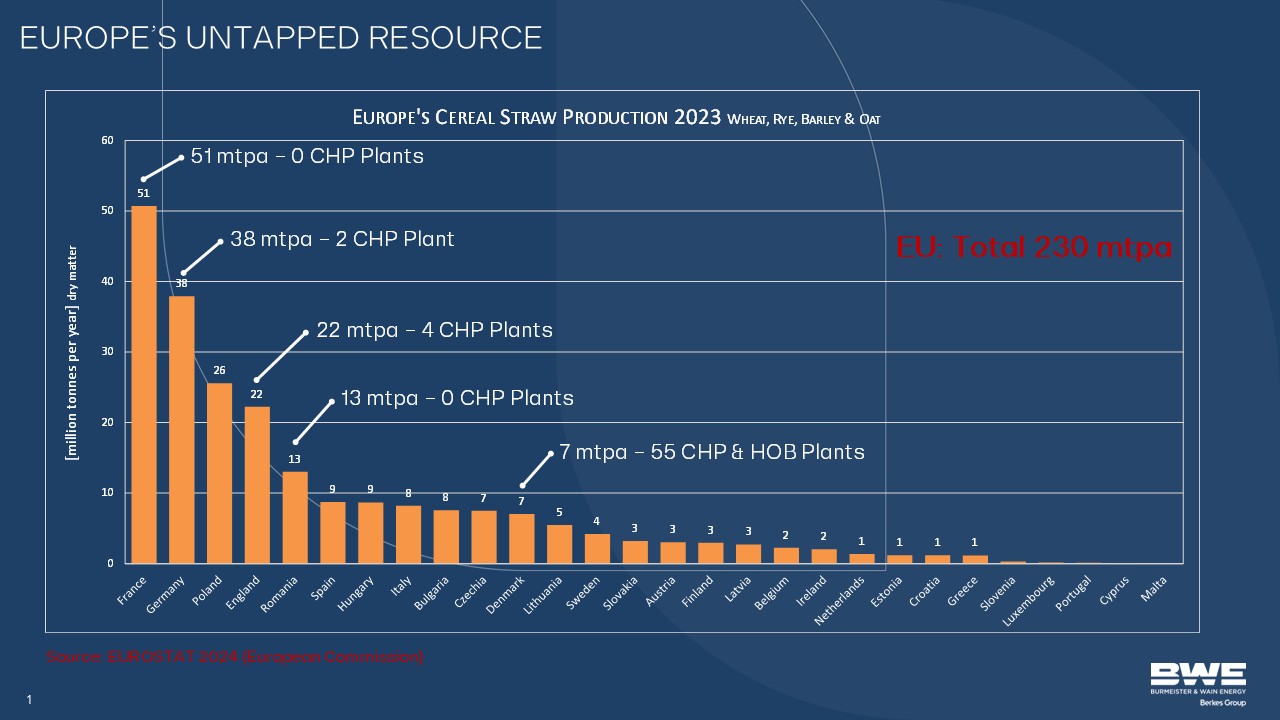
Every year, global agriculture produces vast quantities of biomass residues, straw, stalks, husks and other by-products of food production. These materials are not a niche resource. They are annually renewable, widely distributed, and generated as an intrinsic part of feeding the world.
In Europe alone, agricultural activity generates annually more than 200 million tones of residues. Globally, the scale is far larger. Large agricultural regions like India, China and the United States combined produce more than 2.000 million tones. Through photosynthesis, this biomass represents the removal of 4.000 million tones of CO₂ from the atmosphere every year, occurring as a natural consequence of food production.
Despite the scale, only a small fraction of agricultural residues is purposefully utilized
within the energy system. Much of the resource is left to decompose, returning its carbon
to the atmosphere without delivering additional value - while energy demand is met by
fossil fuels.
This highlights a fundamental opportunity. Agriculture already performs large-scale
carbon capture as part of its normal operation. The challenge, as well as the opportunity,
is to connect this existing biogenic carbon flow to the energy system in a way that delivers
both economic and environmental value.
This untapped resource represents more than an alternative fuel. It is a system lever, one capable of addressing energy security, climate stability, and resource efficiency simultaneously.
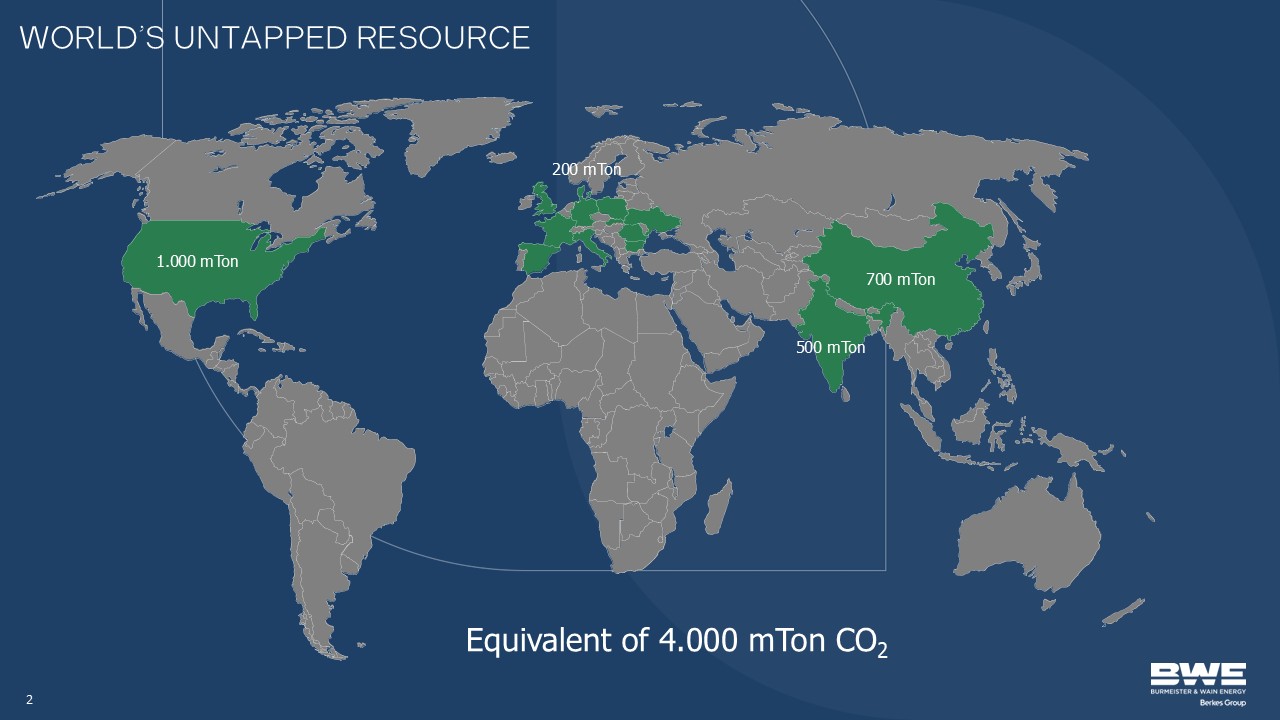
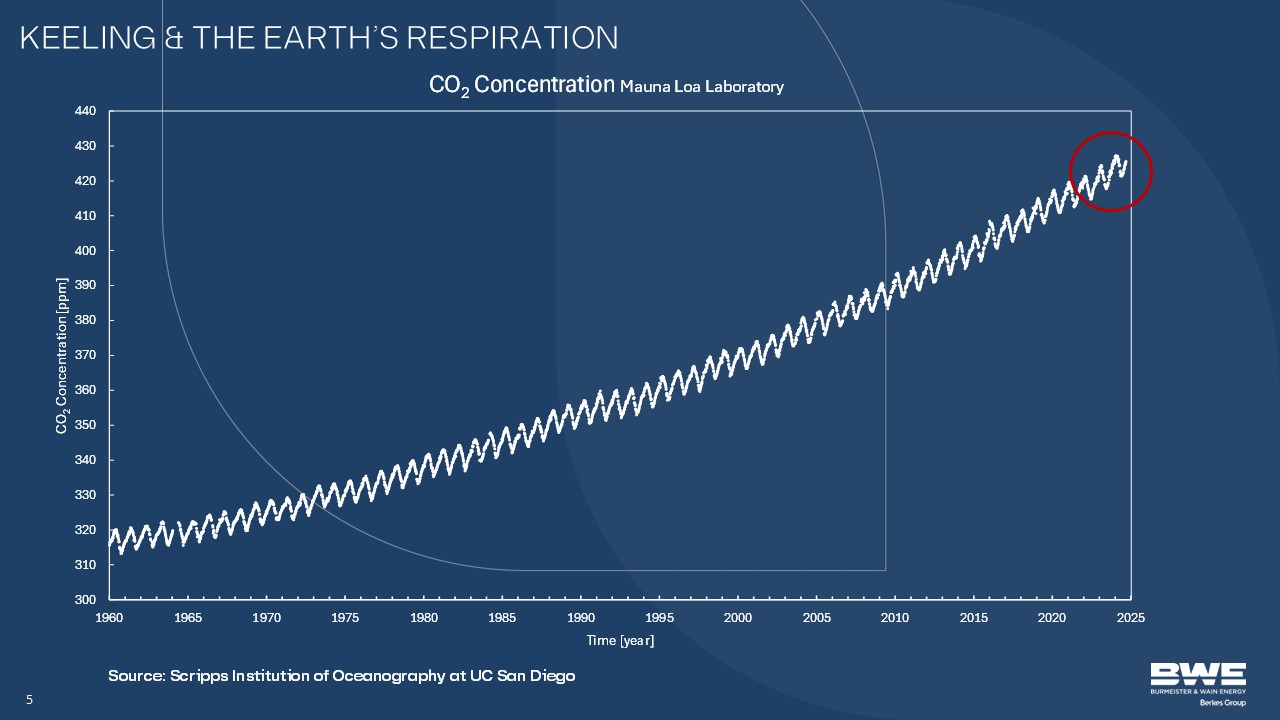
The Keeling Curve is one of the most fundamental indicators of humanity’s impact on the Earth’s climate system. It shows the concentration of carbon dioxide (CO₂) in the atmosphere measured continuously since 1958 at the Mauna Loa Observatory in the Pacific Ocean. The data presented here reflect annual average CO₂ concentrations from 1960 to 2025.
What the curve reveals is unambiguous: Atmospheric CO₂ concentrations are rising steadily and persistently. Over recent decades, concentrations have increased by approximately 2 parts per million (ppm) per year. This rise is not driven by natural variability but represents the net accumulation of CO₂ in the atmosphere, primarily resulting from the combustion of fossil fuels but also the release of long-stored geological carbon.
The Keeling Curve therefore provides a clear physical framing of the climate challenge: Achieving Net Zero is not about reducing emissions alone but balancing the in- and outgoing flow of carbon to and from the atmosphere ... the resulting net addition of carbon.
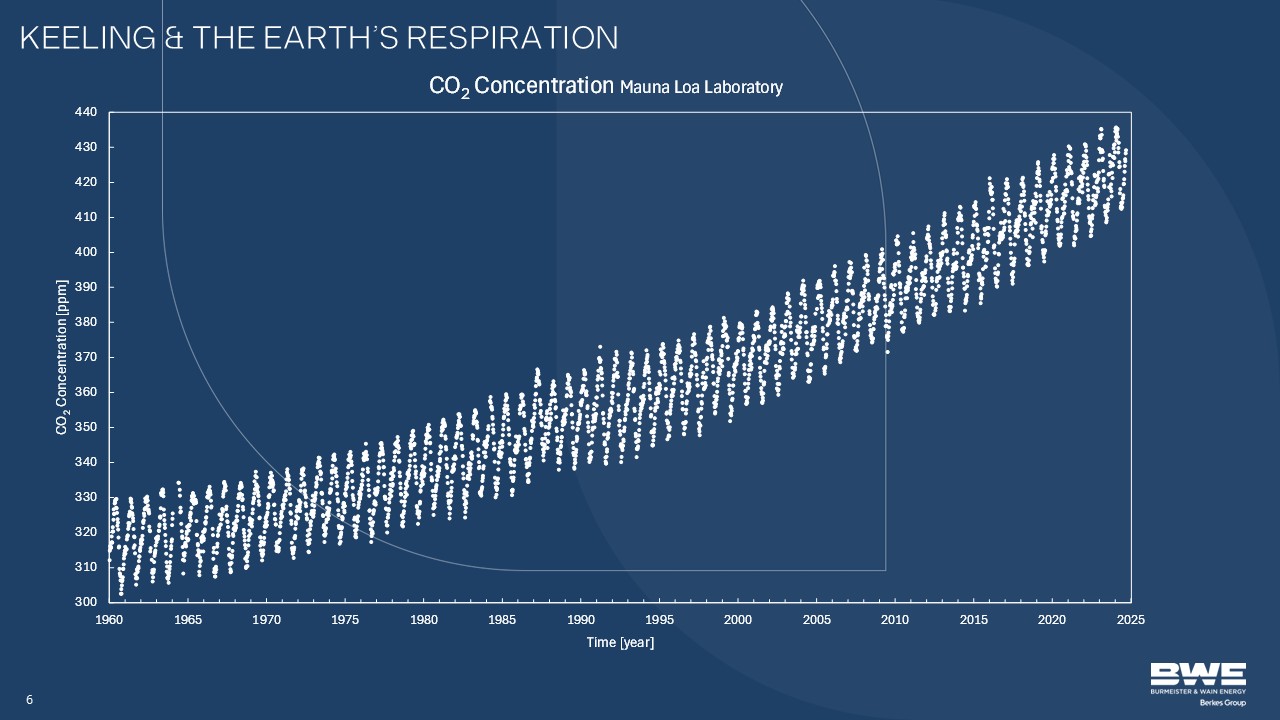
When the same atmospheric measurements are resolved in weekly averages rather than annual averages, the Keeling Curve reveals an additional and highly important dynamic. Instead of a smooth upward line, the curve shows a pronounced seasonal oscillation. Each year, atmospheric CO₂ concentrations fall rapidly by as much as 6 ppm, before rising again just as quickly. This repeating pattern follows the rhythm of the seasons.
This annual fluctuation is often referred to as The Earth’s Respiration. It reflects the biogenic carbon cycle - the natural, short-term circulation of carbon between the atmosphere and biosphere.
Importantly, the magnitude of this seasonal exchange is substantial. The biogenic flux visible in the data is roughly three (3) times more powerful than the net annual influx caused by fossil fuel combustion. In other words, the natural carbon cycle moves vast amounts of carbon every year, far more than the additional fossil carbon that accumulates annually.
While the amplitude of the biogenic cycle is large, it is balanced over time. The fossil contribution, however, represents a one-way transfer of carbon from geological storage into the active atmosphere and biosphere system. This is why, despite the powerful seasonal breathing of the planet, the overall trend continues upward.
The weekly data teaches us something essential: the CO₂ concentration can in fact decrease and even rapidly. This gives us the clue that there is, in fact, a window of opportunity to effectively change the state of our plant, by tapping into this stronger cycle of biogenic CO₂..
Atmospheric CO₂ concentrations are strongly influenced by the seasonal cycles, and these cycles are not uniform across the planet. The majority of the Earth’s landmass and vegetation lies in the Northern Hemisphere; seasonal uptake and release of CO₂ are more pronounced there.
As spring and summer progress in the Northern Hemisphere, large-scale photosynthesis reduces atmospheric CO₂ concentrations, while at the same time, the Southern Hemisphere is moving into autumn and winter, with comparatively lower biological uptake. This creates temporary concentration differences between the hemispheres, causing CO₂ to naturally diffuse from regions of higher concentration toward regions of lower concentration.
This interhemispheric mixing moderates the amplitude of the seasonal CO₂ signal measured at individual locations such as Mauna Loa. In other words, the observed seasonal oscillation is a damped representation of a much larger underlying biogenic exchange.
When this atmospheric mixing effect is accounted for, it becomes clear that the biogenic carbon cycle is not only larger than the net fossil carbon influx … it is vastly larger. While the annual fossil-driven increase in atmospheric CO₂ is on the order of a few parts per million, the gross biogenic exchange, driven by photosynthesis and respiration, is approximately thirty (30) times larger. In the representation shown, the relative difference has been adjusted to a factor of fifteen (15) by intention. It is important to stress that this is not measured but manipulated from the measured data in order to visualize the difference between the actual removal of CO₂ and the net influx of fossil CO₂.
What this teaches us is that the window of opportunity to effectively change the state of our plant for the better, by tapping into this stronger cycle of biogenic CO₂, is much bigger than what the measured data reveal.
The scale and efficiency of the biogenic carbon cycle are such that it, if deliberately and responsibly integrated into the energy system, offers a powerful lever for addressing the current carbon imbalance.
Unlike fossil fuels, biogenic carbon already circulates within the active atmosphere-biosphere system. Using biomass for energy does not introduce new carbon into the system but redirects existing carbon flows. This distinction is fundamental to the concept of Net Zero.
Net Zero is not achieved by neutrality in isolation but by system-level balance. Using the biogenic cycle intelligently allows society to move toward stabilizing atmospheric concentrations—a prerequisite for any credible climate pathway.
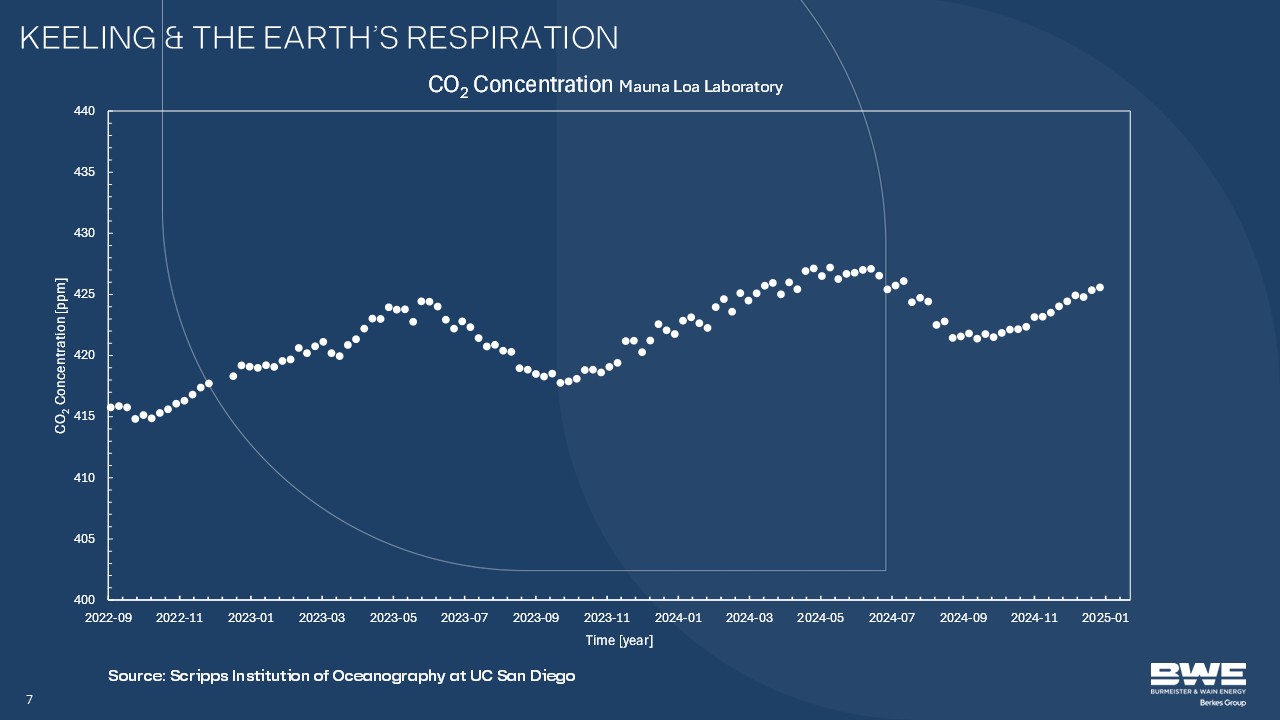
When we zoom in on the most recent years of atmospheric measurements, the contrast between the net fossil carbon influx and the natural biogenic cycle becomes especially clear.
Over a single year, atmospheric CO₂ concentrations fluctuate by approximately 6–7 ppm as a result of seasonal biological activity. Superimposed on this natural oscillation is a persistent upward shift of around 2–3 ppm per year, representing the net addition of fossil carbon to the atmosphere. While the seasonal signal dominates short-term variability, it is the fossil-driven increase that accumulates year by year, steadily raising baseline CO₂ concentrations.
To date, society’s primary response has been to eliminate this net fossil addition by replacing fossil energy with carbon-neutral alternatives. This strategy underpins the large- scale deployment of wind, solar, nuclear power and electrification, including electric vehicles and electrical heat in form of heat pumps, all of which substitute fossil fuels with low- or zero-carbon electricity for the same energy services.
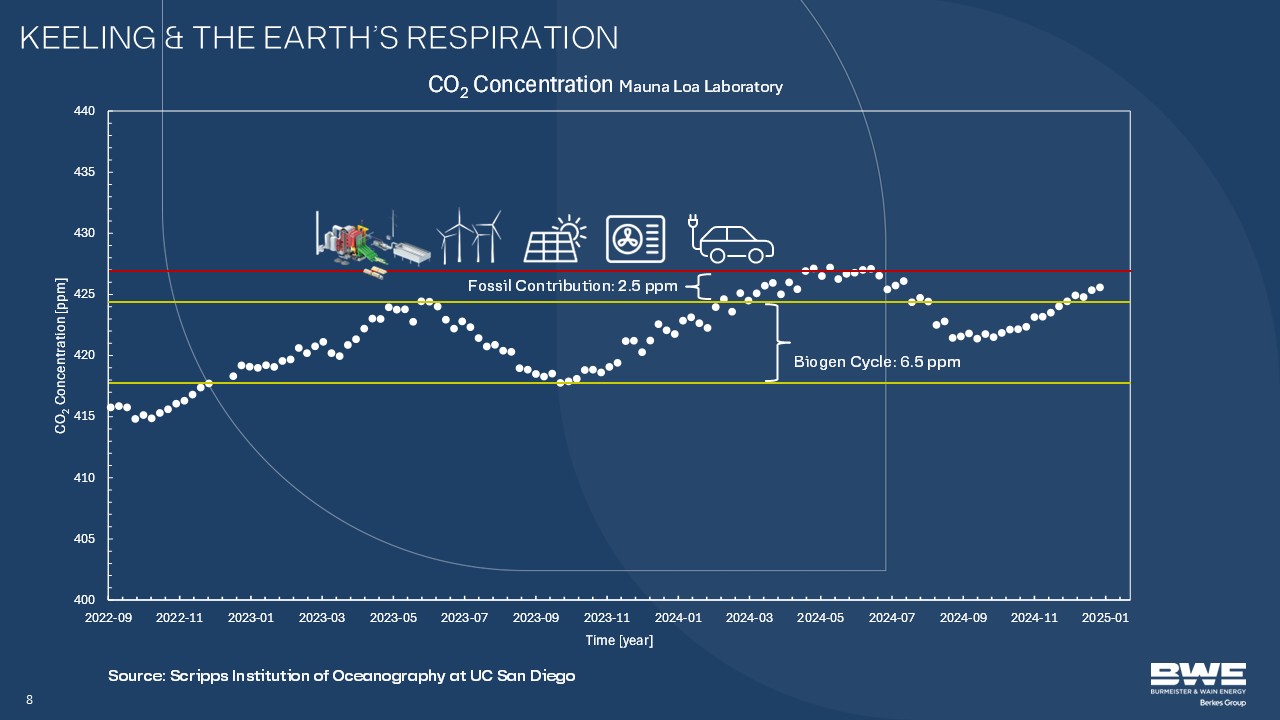
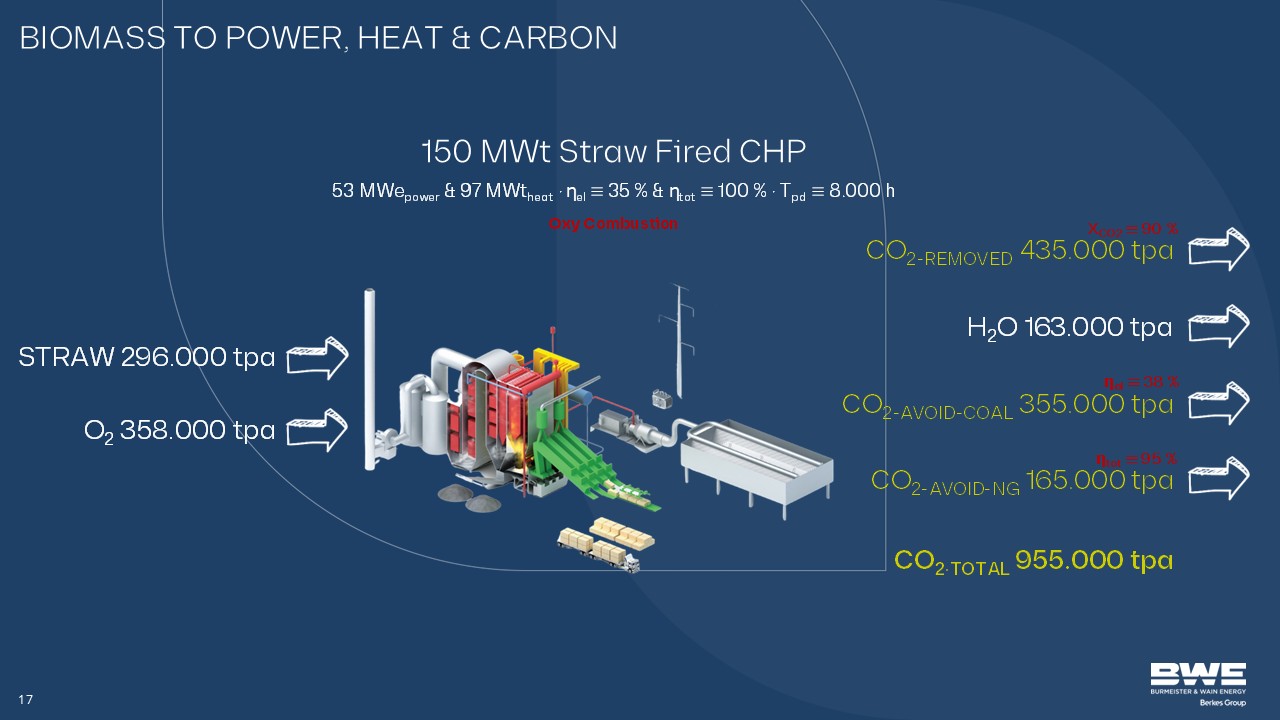
Bioenergy belongs within this framework. When derived from sustainably managed forests or agricultural residues, biomass energy replaces fossil fuels without introducing new carbon into the atmosphere. In particular, combined heat and power (CHP) applications allow bioenergy to simultaneously displace coal-based electricity and gas-based heat, replacing two fossil emission sources within one single solution.
Carbon neutrality, in this sense, is not about stopping carbon flows but about stopping the net addition of fossil carbon. Technologies that achieve this, including responsibly deployed bioenergy, form the foundation of any credible pathway toward stabilizing atmospheric CO₂ concentrations.
Global energy demand is continuing to grow, driven by structural trends such as digitalization, data centers, artificial intelligence, and large-scale electrification, including hydrogen production through electrolysis. As a result, the distance to climate stabilization is not shrinking … it is, in many respects, increasing.
Despite more than a decade of rapid deployment of renewable energy technologies, the effect on atmospheric CO₂ concentrations remains indistinguishable in the Keeling Curve. While wind, solar, nuclear power, and electrification are essential for reducing future fossil emissions, their function is to slow the rate of increase, not to reverse it. Said in another way: Wind, solar, nuclear, and electrical vehicles only slow the speed with which the state of the planet gets worse … it does not substantially improve it.
If the objective is not only to limit damage, but to change the state of the planet, then reducing emissions alone is no longer sufficient. Stabilizing, and ultimately lowering, atmospheric CO₂ concentrations requires the active removal of carbon from the atmosphere.
Most low-carbon energy technologies do not remove CO₂. They avoid emissions and do not reverse the historical accumulation of fossil carbon present in the atmosphere. Bioenergy, however, offers a fundamentally different pathway.
When biomass is grown, carbon is actively extracted from the atmosphere through photosynthesis while storing energy. If this biogenic carbon is converted into deployable and useful energy and prevented from returning to the atmosphere in the form of CO₂, for example, through capture and permanent storage, the result is net carbon removal. At the same time, bioenergy continues to provide carbon-neutral power and heat, directly replacing fossil fuels. Combustion holds the key to not only producing deployable energy in the form of electricity and heat that reduces fossil carbon emissions from similar services, it simultaneously offers an opportunity to effectively remove carbon already emitted.
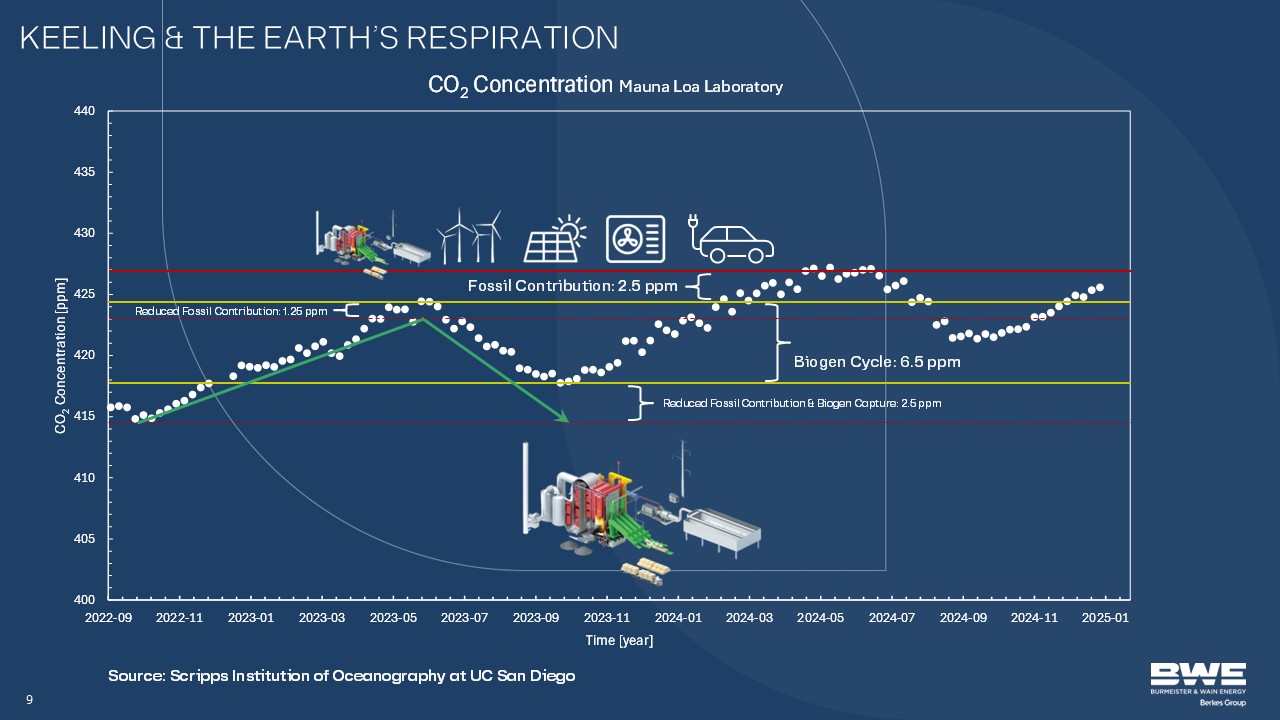
In practical terms, this means that achieving climate goals is not only a question of building more renewable capacity, but of integrating technologies capable of closing the carbon balance and ultimately restoring it.
What this teaches us is that bioenergy, in the form of biomass combustion, especially of our annually renewable agricultural biomass residue, stands as the single most important and influential technology that can be deployed to effectively change the state of our planet.
To unlock the full potential of bioenergy—not only as a source of carbon-neutral power and heat, but also as a means of removing carbon from the atmosphere—conventional combustion alone is not sufficient. Achieving cost-effective carbon removal requires a more advanced combustion approach called Oxy-Combustion.
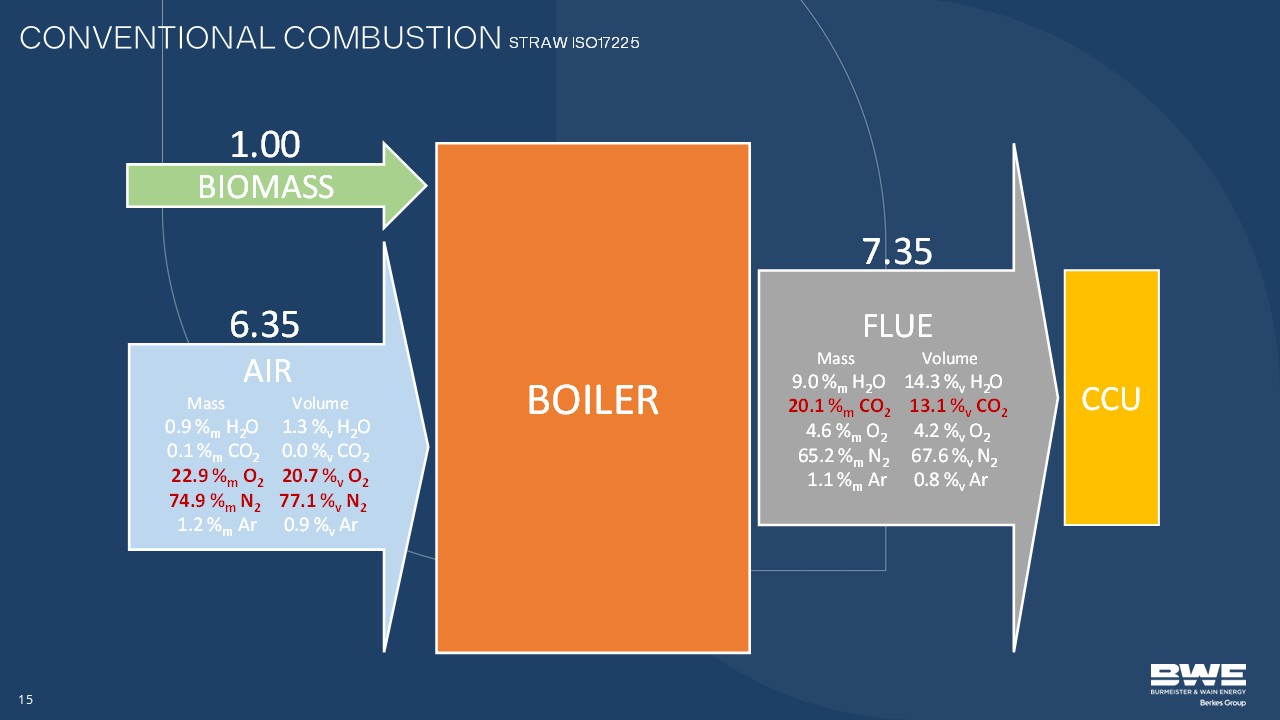
Oxy-combustion is a modified form of conventional combustion in which biomass is burned using oxygen rather than air. In standard combustion processes, air is used as the oxidant. While oxygen enables the combustion reaction, nitrogen—which makes up the majority of air—passes through the combustion largely unchanged. As a result, nitrogen significantly dilutes the flue gas, reducing the CO₂ concentration to 10 - 15% by volume. Capturing CO₂ from such dilute gas streams requires complex, energy-intensive, and capital-heavy carbon capture systems.
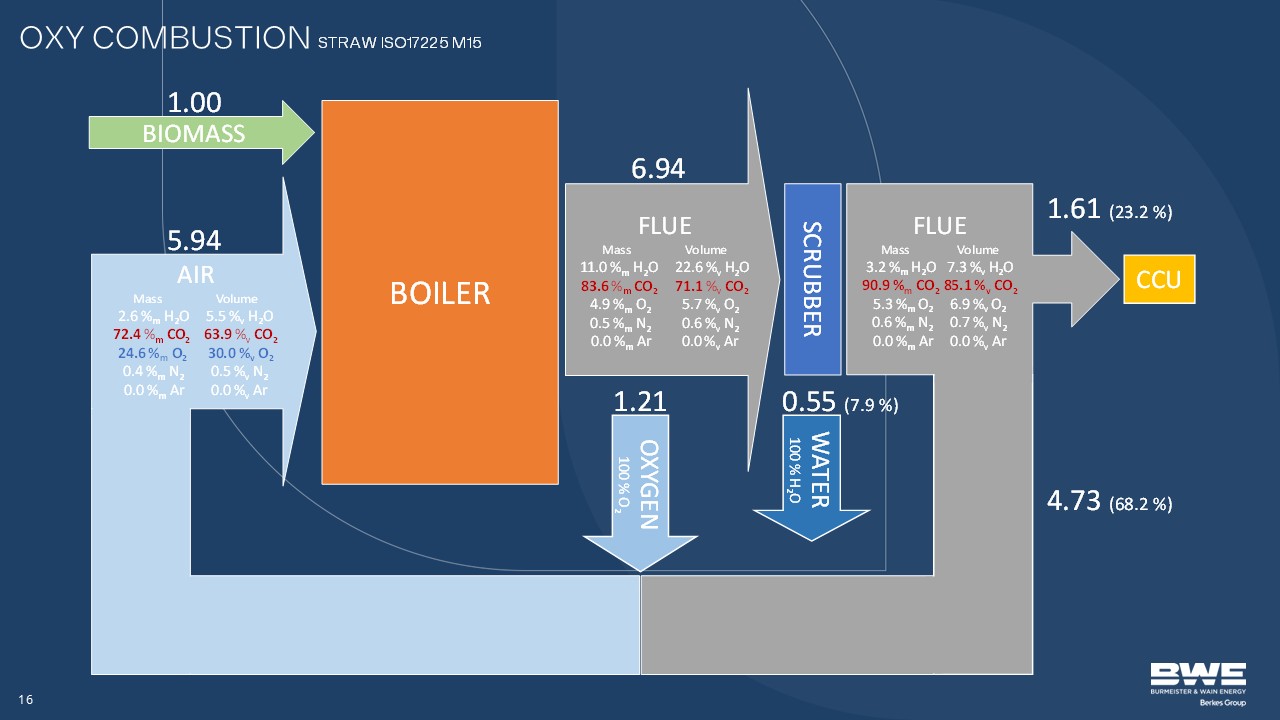
By combining sustainable biomass combustion with oxy-combustion and CO₂ capture, bioenergy systems can move beyond carbon neutrality and deliver net negative emissions. Carbon that was originally extracted from the atmosphere through photosynthesis can be permanently removed while simultaneously producing nearly unchanged dispatchable power and heat.
Oxy-combustion therefore represents a key enabling technology for scaling bioenergy-based carbon removal in a cost-effective and system-integrated way, transforming bioenergy from a substitution technology into a tool for restoring atmospheric balance.